
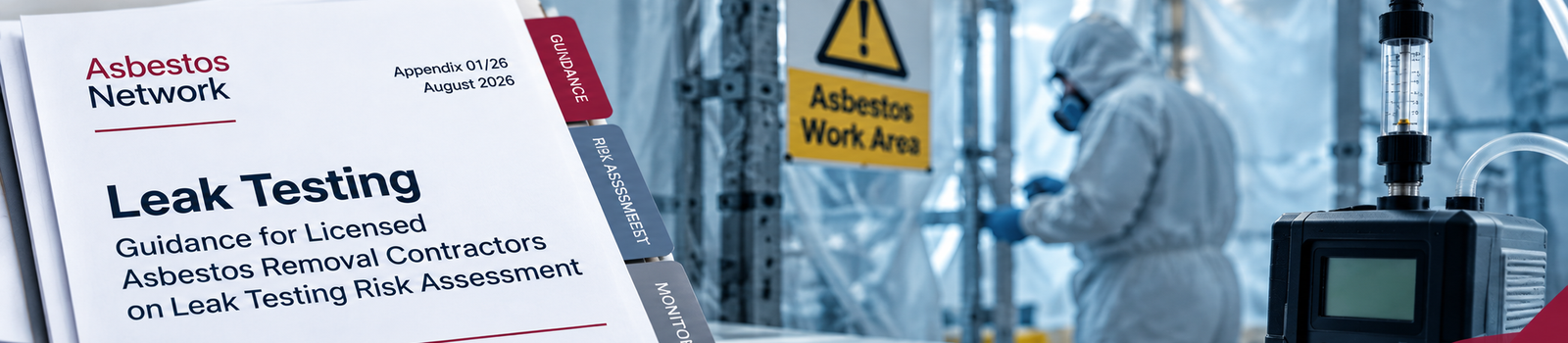
The Health and Safety Executive (HSE) Asbestos Network Technical Working Group has released new guidance to support Licensed Asbestos Removal Contractors (LARCs) in assessing the need for leak testing during asbestos removal activities.
Published on 19 August 2026, Appendix 01/26 – Guidance for Licensed Asbestos Removal Contractors on Leak Testing Risk Assessment provides clarification on the legal requirements, risk assessment considerations and appropriate monitoring strategies associated with leak testing.
The guidance follows discussions within the Asbestos Network Technical Working Group, of which UKATA is a member, and aims to promote a consistent, risk-based approach to preventing the spread of asbestos fibres during licensed removal work.
Why Has This Guidance Been Issued?
The HSE has highlighted concerns over a decline in leak testing during licensed asbestos removal activities in recent years.
Factors contributing to this decline include additional analytical costs, analyst availability, historically low monitoring results and increased reliance on negative pressure systems to maintain enclosure integrity.
However, the guidance reinforces that leak testing remains an important part of demonstrating compliance with the Control of Asbestos Regulations 2012, particularly Regulation 16, which requires employers to prevent or reduce the spread of asbestos to the lowest level reasonably practicable.
Leak testing provides an additional means of verifying enclosure integrity and identifying potential fibre releases that may not be detected through visual inspections, smoke testing or negative pressure monitoring alone.
Key Points from the New Guidance
The appendix outlines several important considerations for LARCs when planning and undertaking licensed asbestos removal work:
- Risk-Based Assessment: Contractors must assess whether leak testing is required and determine appropriate sampling locations and frequencies based on the risks associated with the work.
- Occupied Premises: Wherever reasonably practicable, asbestos removal should be scheduled when buildings are unoccupied. Where surrounding areas remain occupied, leak testing should be undertaken.
- Negative Pressure Units (NPUs): Where an NPU discharges internally rather than outside the building, leak testing should always be carried out at the discharge location.
- Sensitive Environments: Particular consideration should be given to locations such as schools, hospitals and care homes, where the consequences of an asbestos fibre release could be significant.
- Planning and Documentation: LARCs are responsible for developing a proportionate leak testing strategy in consultation with analysts and clients, with arrangements documented in the plan of work. Any decision not to undertake leak testing must be specifically justified and recorded.
- Ongoing Monitoring: A history of satisfactory leak testing results does not automatically remove the need for future monitoring. Contractors must continue to assess risks and verify that control measures remain effective.
Practical Guidance for Contractors
In addition to clarifying the legal requirements, Appendix 01/26 provides practical examples to assist contractors in determining when leak testing is necessary and how monitoring strategies should be developed.
The document considers factors such as anticipated fibre concentrations, the proximity of occupied areas, potential routes for fibre migration and the sensitivity of surrounding environments.
It also includes responses to frequently raised industry questions, covering the limitations of other enclosure integrity checks, the frequency of leak testing and the actions required when elevated fibre concentrations are identified.
Importantly, the guidance reiterates that any single leak test result exceeding 0.010 fibres/ml should trigger an immediate investigation, with work stopped until the circumstances have been assessed.
Supporting Industry Standards and Compliance
UKATA welcomes the publication of this guidance, which provides further clarity for contractors, analysts and other professionals involved in licensed asbestos removal.
As a member of the HSE Asbestos Network Technical Working Group, UKATA continues to support the sharing of technical knowledge and the promotion of high standards across the asbestos industry.
The appendix should be read alongside existing HSE guidance, including L143, HSG247 and HSG248, and is intended to support compliance with the Control of Asbestos Regulations 2012.
Access the Guidance
The full document is available to download through UKATA's dedicated Asbestos Network resource library.
View the HSE Asbestos Network Guidance and Appendices
UKATA encourages members and industry professionals involved in licensed asbestos removal to familiarise themselves with the guidance and review their existing risk assessment and leak testing arrangements where appropriate.
Published on Wednesday 19th August 2026
UKATA tutors can claim CPD.
If you are a tutor login now to see if you can claim CPD on this page.